
All links to official websites of government agencies in the Kingdom of Saudi Arabia end with gov.sa.
All links to official websites of government agencies in the Kingdom of Saudi Arabia end with gov.sa.
Registered with the Digital Government Authority under number :
20250816746
The Saudi Space Agency launched the kingdom’s first sustainable Human Space Flight (HSF) program, which aims to prepare Saudi cadres to become professional astronauts. These astronauts will be launched on both short and long-stay missions to conduct research for the benefit of all humanity. The research focus areas of the HSF program will not only benefit us on Earth but will enable future missions to the Moon and Mars. These focus areas include but are not limited to physical science, human health, biology, biotechnology, biopharma, Earth Science, in-space manufacturing, and technology development. Additionally, these research opportunities will foster international collaboration further enhancing Saudi’s role and contributions globally. The HSF Program is a strategic program that will enable the realization of Vision 2030 through growing Saudi’s technical human capital, diversifying the economy, and expanding sectors in Saudi.
The inaugural mission of this program (SSA-HSF1) was launched on May 21st, 2023. This was a historic mission for Saudi as it launched two astronauts, the first female, Rayyanah Barnawi, and the second male, Ali Alqarni, into space, to the International Space Station (ISS), at a 408 km altitude above Earth, on a short-stay mission, namely, 10 days. On this mission, the Saudi Space Agency engaged scientists and research institutes to develop eleven scientific microgravity research experiments focused on human health, cell science, and weather and climate science. In addition, three scientific outreach experiments were also performed engaging 12,000 students across 47 different locations in Saudi Arabia.

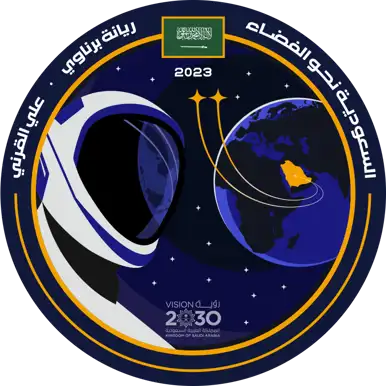
The official patch of the Kingdom's scientific mission to the International Space Station (ISS) embodies its aspirations for the future and its commitment to supporting space exploration efforts, human empowerment, and the protection of planet Earth. The patch combines national identity with global ambitions and reflects the Kingdom's commitment to scientific and technological development and contribution to serving humanity. The patch took a round shape, inspired by the famous window of the International Space Station, which reflects cooperation and communication between nations in space exploration, decorated with the flag of the Kingdom of Saudi Arabia at the top to emphasize national identity and belonging to the homeland. The patch also highlights the Kingdom's location on the world map, as the globe was drawn including details of the map of the Kingdom of Saudi Arabia, which shows the scientific development in the Kingdom at the global level. The patch includes two bright rising stars launching from the Kingdom towards space, representing the two Saudi astronauts, Ali Alqarni and Rayyanah Barnawi, and their ambitions and aspirations towards progress and achievement. The astronaut looking at Earth symbolizes the primary goal of the mission, which is to serve humanity and improve the quality of life on planet Earth. The patch shows 14 stars representing the number of experiments that the Saudi astronauts conducted during their mission to be a symbol of progress in the nation’s skies. The year 2023 indicates the year the Kingdom launched into space and the beginning of its journey in space exploration and achieving its scientific and technological aspirations. The Vision 2030 logo also reflects its role in promoting the development of science, research, and innovation and highlighting the Kingdom’s role in the space sector and its technologies.


Blood-Based Biomarkers
Investigate changes in blood-based biomarkers representing all brain parenchyma to determine if human spaceflight missions are safe for the brain.
Alteration in Telomere Length
Measure the effect of human spaceflight missions on the telomere length.
Pupillometry to Measure Intracranial Pressure
Utilize an automated pupillometer during human spaceflight mission to measure changes in intracranial pressure and further our knowledge of Spaceflight Associated Neuro-ocular Syndrome (SANS)
Use of EEG to Measure Brain Electrical Activity
Determine the effects of the microgravity environment on the brain’s electrical activity using portable EEG.
Optic Nerve Sheath Diameter Measurement
Determine optic nerve sheath diameter in astronauts during human spaceflight missions.
Cerebral Perfusion and Alterations of Brain Position in Microgravity
Utilize near-infrared spectroscopy as a non-invasive neuroimaging technique to measure cerebral perfusion and alterations of brain position in microgravity.
Cloud Seeding in Microgravity
Compare the performance of cloud seeding techniques on Earth and under microgravity conditions.
Cell Science Experiments
Implementation of four experiments concerned with the response of messenger ribonucleic acid (mRNA), its lifespan in space, and effects on inflammation. In addition, an immune cell model is used to stimulate the inflammatory response to drug therapy in microgravity environment.
3 Educational Outreach Microgravity Experiments
There are three different types of experiments, namely, Liquid Fireworks, Space Kite, and Heat transfer focused on fluid mechanics, aerodynamics and heat transfer, respectively. The objective of these experiments is to enable Saudi students to think critically on the effects they can have on the behavior and results of their experiments.
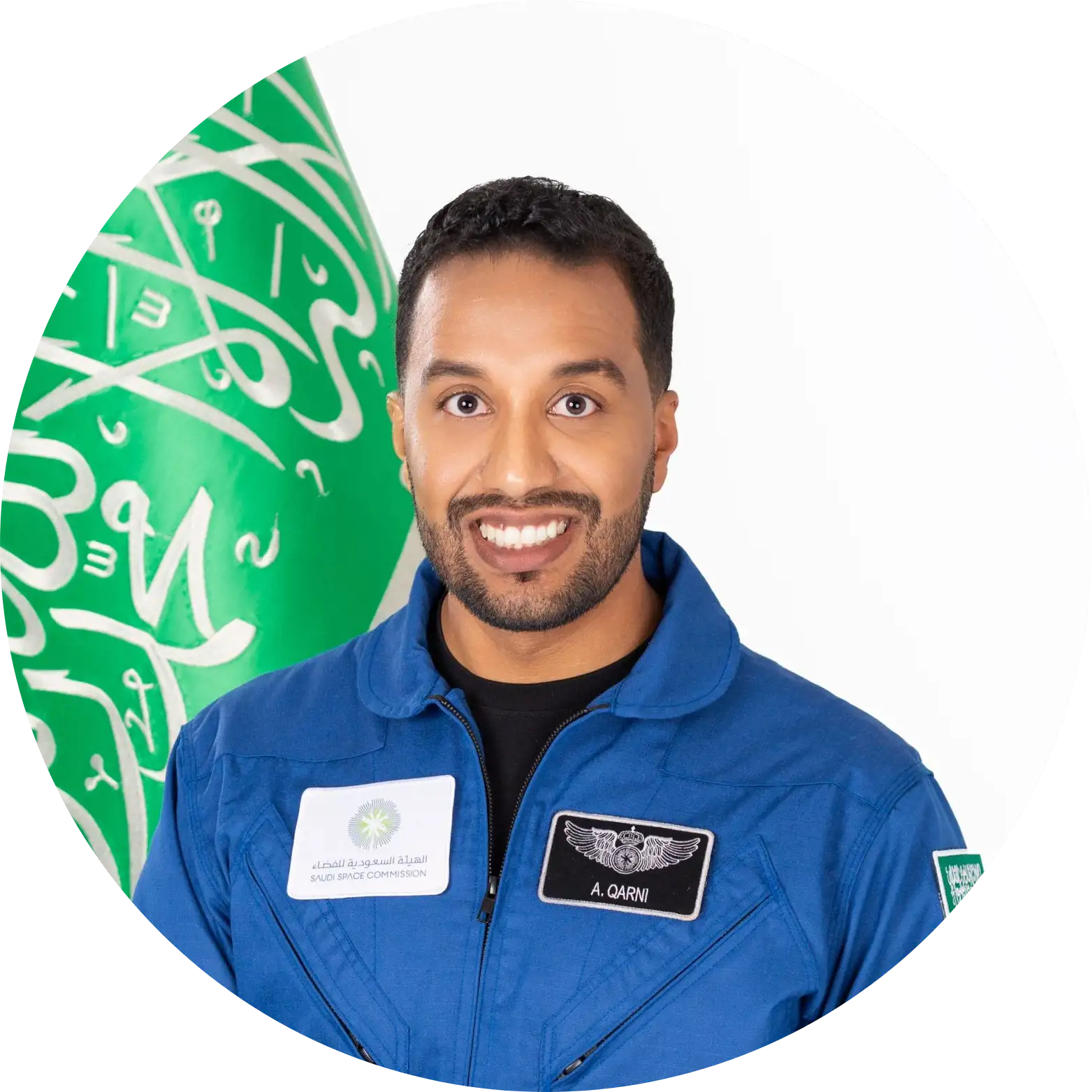
Ali Al-Qarni
Saudi Astronaut

Rayana Bernawi
Saudi Astronaut
To qualify cadres at the highest level to support the objectives of the National Space Strategy and the ability to conduct their research independently in the microgravity environment and the space environment in general.
- Established in 1998
- Established by (5) space agencies
- It is a space research centre, and nearly 3,000 experiments have been conducted
- Its length is 109 m wide (73 m) with a weight of approximately 500 tons
- Orbiting at an altitude of approximately 420 km from the Earth's surface
- Manned by astronauts since 2000
- Complete one cycle around the Earth in every 90 minutes and speed (28,000 km/h)
- The plant uses solar power to generate the power needed for its operation
Short trips (up to 30 days): scientific tasks are carried out in accordance with available duration.
Long journeys (up to 180 days): involves detailed scientific research and requires long-term follow-up and analysis, as well as maintenance and development tasks for some payloads outside the station.
Insulin Pump - Fire Fighting Equipment - LASIK - Wireless Speakers - Water Purification System
Duration (10) days, launched on May 21, 2023.